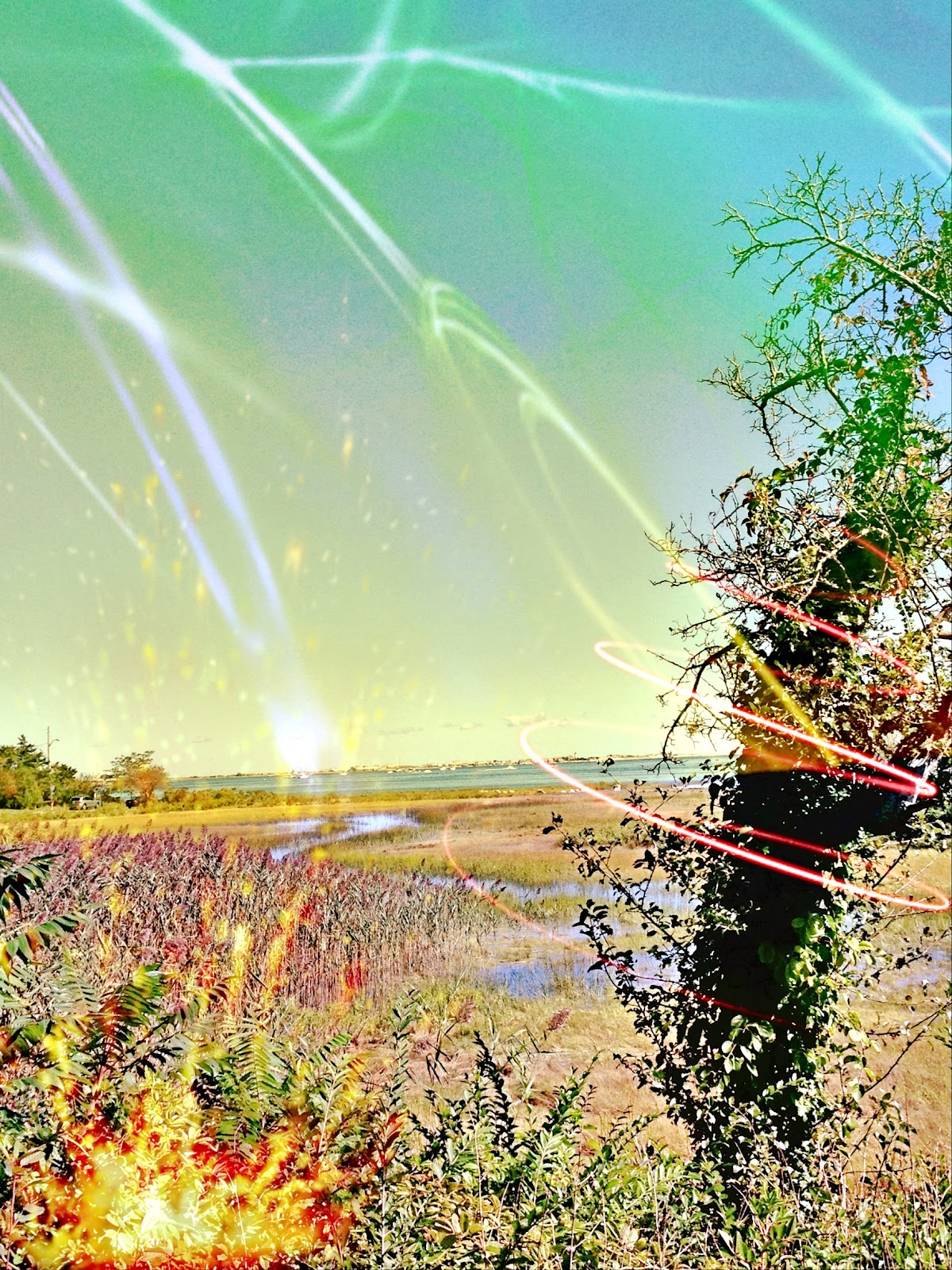
Last week, after Sandy gnashed her way northward, I took a drive down to the town of Westerly at the southwestern tip of Rhode Island (which, it appears, is too tiny to give mention in the Wiki link provided, other than to power-loss numbers), where I manage a small shopping center, and then turned back north, up along Rhode Island's coastline. Our 8,000 square foot center, which is about a mile in from the coast, did fine with the exception of the loss of two south-facing signs on the center's large pylon, but much of the southern coast of this little state was reduced to rubble by Sandy's outer bands of wind and storm surge, and several homes along Westerly's Misquamicut beach seemed to be devoured whole, trace timber crumbs scattered along the shoreline.
The she-storm's aftermath felt oddly quiet. Maybe, though, it was just my mind. My mind taciturn. I could not locate words as I drove past stretches of rough-surf beach and golden farm and tragically but beautifully broken stone walls—all kinds of debris spewed across field and road and beachfront but not a word to be found. I took pictures and made mental notations, wondering how many insurance claims one company can handle, absorb. I would need to make a call myself. When I found the words.
Just beyond the breachway, as I sat in my car at the edge of Wawaloam Drive in Weekapaug, overlooking Block Island Sound, I thought, too, about poetic sequence, in particular mine (you know, the one I'm writing, the theme of which is my expectation of and ultimate disappointment with New England's seasons), how I had developed only a loose narrative in the five poems I'd written to date, and how I hadn't yet written a sonnet. Here, certainly, was drama enough for sonnet, and, well, I must write a sonnet! On my northward drive I turned east toward Moonstone, but when I arrived the beach had been closed off entirely. Standing at the cordoned off gate of Moonstone Beach Road, watching military helicopters whirling across the sky, listening to the ocean's post-Sandy low-pitched hymn, inhaling its aroma, swallowing the romantic pinks and purples of a warm aurora, the silent, wordless current cascading through the narrow valleys of my mind was instantly, galvanically, awakened and I knew at once what I hadn't before fully digested: my poetic sequence was not only about my expectations, my disappointments—how I perceived seasons to be failing in almost legendary fashion—but rather a sequence that speaks to the much larger and universal issue of climate change. And Sandy, this badly behaved November storm, came with her own tale, a growing thematic narrative, one of which might well be called Global Warming.
What had I taken on?
Springsteen's Sandy may never have come back, but I have this woeful feeling that she-storms like Sandy will return with more frequency, with high drama and little romance, and in their wakes will leave the same catastrophic hymn, salty aroma and burning aurora as Sandy. I wonder how this will change the game, what bills we'll bring to congress, which shall pass into laws, and which laws—other than zoning laws which shall certainly be modified to address the rising seas—may be nullified or amended.
(Just this morning, Think Progress posted an article which asks if Sandy is "[...]a 'Cuyahoga River Moment' for Climate Change." Cuyahoga is the Ohio river that, at one time, was known for being the most polluted river in the US. Littered with trash and slicked with oil, it burned several times; it's infamous 1969 burning sparked a number of water pollution laws, including the Clean Water Act.)
What are we taking on?
At tonight's high school soccer banquet, no one seemed to be talking politics (but then again, I don't bring it up). But I know tomorrow, at the polls, I won't be the only voter wondering, and maybe gabbing about, which candidate will address and act upon the very real threat, the course, of global warming. Who will truly be compelled to honor the subject, ask central questions, demand answers, reckon with his presidential sensibilities, and see it through—bringing real action and change. This is much more than politics, and I wonder who prefers writing the poetic sequence over the punchline. There is an aurora rising behind and above us. Poetry. Pure poetry.